I want to say that style should proceed from substance, but I do not know precisely what I mean by this.
Imagine a blog written on the topic of French Cuisine that featured a background of a .jpg of homeless man repeated across the Y Axis along the top. This style is utterly irrelevant to the content of the blog - it would be a bit of surrealism or an attempt at being 'random,' and nothing more.
But when we see American twenty-somethings wearing a hooded sweatshirt with a fleur-de-lis on it, well, no one thinks that is surreal.
If I stamped my hands on the keyboard to produce nonsense text, well, we would think it odd that text was produced that communicated and symbolized nothing. But a screen door with metal twisted into curls symbolizes what exactly?
Perhaps you will object that it is just a bit of decoration and it was not intended to show or tell anything and that expecting it to show or tell something means I do not understand the goal in which it was created. This brings me back to what I said initially, I want to say that style should proceed from substance. Perhaps what I mean by this is that there should be no decoration that lacks relevance.
That is, it makes sense for a man with the last name Murray to have metal bars welded onto his screen door in the shape of a letter 'M.' It makes less sense for someone named, say, Dunahue. It makes sense for a church to prominently display a cross on top of their building, but a steeple is empty decoration*, style that does not proceed from substance. Look at this blog itself - I chose the Awesome Inc. template because it was pleasing to my eye and because I prefer white text on a dark background, but why are there diagonal lines streaking down the background? What do those indicate? Celebrate? Dedicate? Why are they there? Only to be pleasing to the eye?
Is being pleasing to the eye enough?
This may be a matter of personal preference. I prefer a thing to be functional and without decoration if I can not find some significance to the decoration. But then in the case of a question-mark, letters, flowers used as symbols, flag colors, and ninety-percent of band logos, the symbols themselves are arbitrary and only later receive significance from the nature of what they decorate. This means a bit of style may not proceed the substance, but later takes part in the substance.
So, for the moment, I conclude only that decoration without meaning is, to me at least, ugly and unwelcome.
*the historical use of the steeple has given the steeple significance; no doubt there is also some other deeper meaning that someone more familiar with church architecture could highlight. My example should still be illuminating if it is taken in the understanding in which I wrote it.
Showing posts with label Creativity. Show all posts
Showing posts with label Creativity. Show all posts
Wednesday, March 27, 2013


Monday, November 12, 2012
The Best of Christianity and the Bible

But, then, it is just convention and tradition that elevates the Bible so high that we regard it as the only appropriate foundation for Christian thought.
How can we regard the Christian thinker, then? I suppose we must regard him as any other thinker. His work is an amalgamation of what he finds beautiful, what he finds useful, what he finds necessary to support the former, what appeals to his biases, what draws him out of himself, what he was educated into, what he must rebel against, what makes him feel strong, what makes him feel safe, in short, what he can live according to.
But what then is Christian thought? Orthodoxy can only exist in a relative sense. Define "good thought" and then you can compare your definition to whatever someone offers for consideration. But then, they can merely reject your definition. Sound doctrine, orthodox thinking, this is merely the attempt to align one's thoughts with an arbitrarily grasped form of truth.
Which is probably why the best Christian thought seems to depart so far from what we could reasonably derive from the verses that inspire the thought - because the scripture is a trigger, but the individual and the totality of his life provides the content.
As an atheist, I say that this shows the unreliability of all religious orthodoxy. As one who is and probably always shall be interested in becoming a theist, I say that this, coupled with a kind of determinism, is the nature of revelation.
Tuesday, August 7, 2012
The Cosmology of Gotham City

I love comic books, as a medium. Comics operate in two languages: written text and visuals. They're a middle point between the nigh-limitlessness and descriptiveness of literature and the understatement and optional depth of visual media. A drawing can be dense with information and meaning or it can be light and stylish; the reader can decide how much time he spends on the visuals and how much information he tries to gather just from what is drawn. And the text, due to the fact that it is delivered in quick, bite-sized chunks at a time, allows for a faster pace than most books allow.
I love them as a medium, but I just can not seem to really immerse myself in them as they exist in their periodical format. For me, Batman is the reason to read comic books. Watchmen too, but that does not count for the current topic, I am talking about the never-ending periodically published comics. I can not bring myself to immerse myself in them, and that is because their genres and plotlines unravel as new material is needed, and this makes it impossible to get a sense of unity from the books.
For some, unity is not that important. I am not one of them.
What annoys me about periodical comic books is their tendency to become so inconsistent over time. Characters die, but didn't really die. Awesome characters become ridiculous. Demons and ghosts appear in otherwise realistic tasting works. Beloved characters get killed, but there's some kind of reset, so that an identical character exists but you always know that it's technically a different person. There is no sense attempting to change this, really, it would be impossible to deliver the same product to each generation and it would be nigh-impossible to not delve into either insipidness or weirdness when trying to consistently produce interesting and entertaining storylines on a consistent basis.
So, it is left up to the reader to develop his own consistency. Batman being the only one I am really concerned about, it is necessary to develop a cosmology of Gotham City. The persistent and enduring soul of all Batman storylines. For me, this is that system:
In my conception of the Batman mythos, there is no age or decay in the world. The Dark Knight Returns is just a fever dream; Batman never reaches that age. Growth occurs, but not real aging. Gotham City is a giant chaotic battleground full of conflicting wills, but it is one that is also balanced through the very clash of wills that makes it chaotic in the first place. Gotham is one of the few places on earth that has not been brought under a more-or-less united system of values, instead it is place where any sufficiently powerful entity can try to remake the city in his or her image. So you have the Joker trying to make the city into one giant, bloody punchline because the only thing he loves is the anarchy of laughing at everything. Two-Face wants to create a world of duality because his nature is defined by duality and he is powerful enough to impose the peculiarities of his nature on the world around him. Likewise for Poison Ivy and plants, Mr. Freeze and cold, and the Riddler and intellectual masturbation. No matter how idiosyncratic, you can try to make the world in your image in Gotham.
Arkham is the cooling off box. The idiosyncrasies don't die, they just go into remission for a time. The police are a moderating force for a flattened out order that favors letting people live their lives according to their desires, but not imposing their desires on others, but they are too weak to prevail. Gotham is bound to belong to one of the magnificent figures in the city, whichever one proves to be most capable.
And the Batman story is the story of one freak who is great enough to prevail over all others, but then chooses not to force his will on Gotham except insofar as necessary for the citizens to lead their own private lives. Batman is always smart enough, always strong enough to prevail; Batman can only lose temporarily, he will always prevail in the end. And his will is strong, but he has self-mastery and through the use of a handful of strict rules he forces himself to see himself as a servant instead of a master. If he were to ever fail to practice his code of self-discipline, Gotham would fall into anarchy, Batman is the force that keeps Gotham balanced. And it hurts.
Batman is in constant pain. Physically, mentally, emotionally, the guy is writhing in pain. He can't have the satisfaction of cutting loose, he can't retire, he can't lighten his load, he can't go too far, he can't have the things that would bring him private happiness. It hurts him. That is the order of Gotham: as long as Batman is willing to suffer, the world keeps working. He might believe that he has to do this, but we, the audience, know that he does not. We know that he has chosen to lead his life and that he continues to choose it every day. And he will suffer for it.
To me, this is the cosmology of Gotham. From this system, we can experience the tragedy of Bruce Wayne's sacrifice, the thrill of seeing someone as powerful as Batman consistently prevail without any supernatural powers that insure his safety, the hope that Bruce can carve out little slices of happiness for himself, and the fascination of watching the strange and the insane fight to acquire their own little pieces of Gotham.
Friday, August 3, 2012
Craft and Entertainment
I once wrote that, "all Art is a picture of remixed Nature." My main idea being that art is a creative - and intentionally distorted - reflection of reality. You will never find something in art that is not first found somewhere in nature, it's just that art can play with the proportions and remove undesired elements at will.
And as I say ad nauseum (mostly regarding ethics rather than aesthetics, though), values belong to the subjective individual, there is no factual objective good and bad.
But it occurs to me that there is another distinction we can make of Art that may be a bit more interesting. I call these two distinct forms of Art, Craft and Entertainment. They are not necessarily mutually exclusive, but insofar as a work of art is Craft, it is probably not Entertainment to most people, and insofar as it is Entertainment to most people, it is probably not Craft.
Craft
 Craft is Art that proceeds from the peculiarities of the Artist's heart/mind/perspective/value rather than the commonalities. Craft is not intuitively appealing, Craft does not have wide appeal, Craft is esoteric, obscure, and mysterious. The reason for this being that it is created according to a vantage point that you probably do not use yourself.
Any given person is likely to have a lot in common with a lot of other people, some things he will have in common with all other people, but there will be some things so peculiar that only a handful of others will share them, and to some degree everyone is a unique snowflake. It is possible to create Art that remixes the world in a way that pleases the peculiar or unique parts of an Artist's nature. The resulting Art is a challenge to the audience.
The challenge is this: is there enough beauty in the Art, as it appears to you now, to compel you to understand it?
We philosophical types tend to have our heads shoved too firmly up our own asses to admit that we sometimes come across things that we do not understand, but that we feel is above us rather than incoherent or beneath us. But it happens. And if you don't have that characteristic arrogance, you have probably encountered movies or books or songs that seemed like they promised you something new and something great if you could just find a way to get behind them. If you could understand them. If you could figure them out.
That is the effect of some Craft. Of course, it is also possible for Craft to just be dismal. The Human Centipede probably sprang from some esoteric parts of Tom Six's character, that doesn't mean that it's worth trying to get behind or a point of view worth trying to acquire. But, then, that's how The Human Centipede impresses itself upon my character via my perspective; a different character and a different perspective might feel differently.
The essence of Craft is how particular it is to the Artist that created it.
Entertainment

Entertainment aims to please. It wants to provide a service to the audience, and for that reason does not try to lead the audience anywhere that it might not want to go. Where Craft beckons the audience to go chasing, Entertainment offers the audience a seat and sets up the stage nearby. As a consequence of this goal, an Artist creating Entertainment tries to limit the influence of his peculiarities, the Artist wants to focus on common ground between himself and the audience, or if necessary will even try to appeal to sensibilities that he does not share (like an director who makes movies for babies).
There is nothing inherently wrong with Entertainment, but there are those snobs who want to turn their nose up at anything that exists for people where they are instead of people who have reached a certain kind of special vantage point or expertize (of course, that's basically what a snob is, isn't it? Someone who supposedly sees things that you do not, and looks down at you for the sake of elevating his advantage).
For the consumer with an eye toward the evolution of his character, there are two things to keep in mind regarding Entertainment. Entertainment will not move you forward, you will not evolve or grow from Entertainment. However, Entertainment is also an exercise in being what you are. If you have an aggressive nature, consuming aggressive Art will let you indulge in being who you already are; a sexual character watching pornography is being who he is. And if you do not exercise your present state of being, well, then how are you really yourself?
I imagine that this distinction will be revisited often in the future.
And as I say ad nauseum (mostly regarding ethics rather than aesthetics, though), values belong to the subjective individual, there is no factual objective good and bad.
But it occurs to me that there is another distinction we can make of Art that may be a bit more interesting. I call these two distinct forms of Art, Craft and Entertainment. They are not necessarily mutually exclusive, but insofar as a work of art is Craft, it is probably not Entertainment to most people, and insofar as it is Entertainment to most people, it is probably not Craft.
Craft

Any given person is likely to have a lot in common with a lot of other people, some things he will have in common with all other people, but there will be some things so peculiar that only a handful of others will share them, and to some degree everyone is a unique snowflake. It is possible to create Art that remixes the world in a way that pleases the peculiar or unique parts of an Artist's nature. The resulting Art is a challenge to the audience.
The challenge is this: is there enough beauty in the Art, as it appears to you now, to compel you to understand it?
We philosophical types tend to have our heads shoved too firmly up our own asses to admit that we sometimes come across things that we do not understand, but that we feel is above us rather than incoherent or beneath us. But it happens. And if you don't have that characteristic arrogance, you have probably encountered movies or books or songs that seemed like they promised you something new and something great if you could just find a way to get behind them. If you could understand them. If you could figure them out.
That is the effect of some Craft. Of course, it is also possible for Craft to just be dismal. The Human Centipede probably sprang from some esoteric parts of Tom Six's character, that doesn't mean that it's worth trying to get behind or a point of view worth trying to acquire. But, then, that's how The Human Centipede impresses itself upon my character via my perspective; a different character and a different perspective might feel differently.
The essence of Craft is how particular it is to the Artist that created it.
Entertainment

Entertainment aims to please. It wants to provide a service to the audience, and for that reason does not try to lead the audience anywhere that it might not want to go. Where Craft beckons the audience to go chasing, Entertainment offers the audience a seat and sets up the stage nearby. As a consequence of this goal, an Artist creating Entertainment tries to limit the influence of his peculiarities, the Artist wants to focus on common ground between himself and the audience, or if necessary will even try to appeal to sensibilities that he does not share (like an director who makes movies for babies).
There is nothing inherently wrong with Entertainment, but there are those snobs who want to turn their nose up at anything that exists for people where they are instead of people who have reached a certain kind of special vantage point or expertize (of course, that's basically what a snob is, isn't it? Someone who supposedly sees things that you do not, and looks down at you for the sake of elevating his advantage).
For the consumer with an eye toward the evolution of his character, there are two things to keep in mind regarding Entertainment. Entertainment will not move you forward, you will not evolve or grow from Entertainment. However, Entertainment is also an exercise in being what you are. If you have an aggressive nature, consuming aggressive Art will let you indulge in being who you already are; a sexual character watching pornography is being who he is. And if you do not exercise your present state of being, well, then how are you really yourself?
I imagine that this distinction will be revisited often in the future.
Thursday, August 2, 2012
Setting Finger to Keyboard
I write one page of masterpiece to ninety one pages of shit.
-Ernest Hemingway

I finished my first 1000 words yesterday, and in the course of it, contemplated scrapping the entire project. I even had an opportunity to do so when I realized that my announcement blog did not post at midnight like it was supposed to, so I could write up a different project and could avoid owning up to the failure altogether. Just reading a few paragraphs of my clunky prose made me see myself as too untalented to bother continuing, and reading my words appear on the screen never tickled my pride or excitement enough to compel me to go on. Worst of all, my chief motivation is the desire to have a novella written, rather than my desire to have a particular novella written. I'm writing without inspiration or without an idea or theme to build on; I have a rough outline and a handful of themes in mind, but they were chosen after I decided to write the book, they did not inspire the writing.
So I have about as much emotional fuel as a bored bureaucrat who has a set number of forms to review each day. This does not bode well for the quality of the material, or my endurance of the project. But there is one thought that I am trying to keep in mind throughout the writing:
It doesn't have to be good, it just has to be complete.
I'm sure that those with some writing experience are cringing right about now, but this is the philosophy that I think will carry me through this project. I am not approaching it as a potential masterpiece, I am approaching it as an experience that I want to have. If one day I ever do write something worth someone pirating online, then this novella will be practice for that day. If I do not, then this novella project was at least a case where I saw a creative act through to completion.
Mostly, this novella gives me a reusable lump of clay for the future. I can edit it, I can rewrite it, I can tweak it, I can modify it. Whenever I find an interesting literary technique, this novella gives me pre-written material that I can rewrite using the new technique, letting me look at it from the perspective of a writer and not just a reader.
Writing shit is the first step to writing something better. So, I will endure. But today, my prose still sucks.
Wednesday, August 1, 2012
A Novella in Thirty-One Days

August is just another month as far as writing is concerned. I have decided, however, to devote this month to a creative exercise. Less ambitious than NaNoWriMo, but with an equally dismal emphasis on quality, I am aiming to write a novella in thirty-one days. Specifically, a 31,000 word novella, which requires that I write at least 1000 words every day for thirty-one days.
What will come of this? Well, my chief aim is to have something that I can call a completed work that belongs to me. Whether or not it's any good is not my primary concern, once it's finished I can always work on molding it later. Naturally, I am going to try to make it coherent and try to make it something that I can be proud of, but this is all secondary for the month. I am not a professional author, so I get to approach the whole thing with the enthusiasm of a hobbyist.
What results from it, I am eager to see.
So what will my blog consist of during these thirty-one days? Chapters? Nope, I don't plan to post the novella on my blog at this time. Instead, I want to try to use the month to focus on aesthetics, entertainment, art, and literature. In other words, less epistemology and ethics, more aesthetics, preferences, and examinations. Sprinkled throughout will be anything I happen to notice during my effort to produce something written and complete.
Of course, I'm sure I'll work the epistemology and ethics in there somehow.
EDIT: This did not come to fruition, but it did help me clear out my head.
EDIT: This did not come to fruition, but it did help me clear out my head.
Wednesday, July 25, 2012
Wherein I Ramble About The Dark Knight Rises

All of these should be read in the context of the judgment that this was a good movie. Also, Spoilers.
- Bane was an awesome villain. He was something we have not really seen yet in Nolan's films: a rival for Batman. Because Bane had physical strength and brutality, which Joker, Two-Face, and Scarecrow lacked (Ra's al Ghul had some of that, but Batman was always more physically imposing). Bane was a symbol of a new order, which he established through fear and power, just like Batman established a new order opposed to the mobs through fear and power; the Joker was about anarchy, Two-Face was about perverse fairness and revenge, and Ra's al Ghul was about righteous destruction. Even in the seemingly superficial details Bane is similar to Batman: he is masked, his voice is obscured, he has an underground dwelling where he prepares for his above ground activities, he's at home in the shadows and in obscurity. Bane was not Batman's antithesis, Bane was cut from the same cloth, and was perhaps in some ways the superior between the two.
- But everything that was so great about Bane was ruined at the end when Talia al Ghul came into the picture. I spent that entire movie waiting to watch Batman prevail over Bane; I wanted to watch Batman display superiority over his mirror image, and we never got to see that. Batman damaged his mask, had about a minute of superiority over him, and then was overcome by Talia. At this point, Bane takes on the role of a high-ranking goon, and is dispatched with about that much concern when Catwoman blasts him away with the Batpod.
- The ending felt like a cop-out, but it wasn't. It has the initial appearance of a cop-out, because you become emotionally prepared for Bruce Wayne to die. You realize that this is a gritty, 'realistic' Batman film, and that means that if Bruce has to sacrifice himself to save Gotham, he will, and nothing will change that fact.
But this is not the case. It would be wrong for Bruce Wayne to die in the explosion. Only Batman should die. This is the only proper ending for a Batman universe: Bruce Wayne and Gotham moving beyond Batman. This, coupled with Catwoman's redemption arc make it the best aesthetic choice. However, it will continue feeling like a cop-out, because we are distrustful of heroes who do not really accomplish what they appear to accomplish. - This movie addressed what so many fans failed to address at the end of The Dark Knight, which is that lying to Gotham about Harvey Dent was not heroic. The fact that Gordon was taken to task for that, and that he has struggled with it for years, pleased me.
- This film was necessary to tie Batman Begins and The Dark Knight together. It's closer to Batman Begins, but ending on that note sort of ties the whole thing together. BB showed how Batman came to be and why Gotham needed him. TDK showed that Batman could become hazardous by inspiring madness and insanity. TDKR completed this arc by letting Batman do what he was needed to do, and then leave upon fulfilling it, avoiding the deficit of no Batman and the excess of Batman bringing out insanity.
- Bruce Wayne and Selena Kyle's romance was handled perfectly. It was unrealistic and utterly undeveloped. This is how Batman and Catwoman's relationships should be: they shouldn't be explored, there should be something raw and unintelligible to them.
- Revealing that John Blake's real name is "Robin" provided a brief fanboy thrill. A brief one. It dissipates quickly and you're left realizing that it was probably not an improvement on the film. He certainly isn't going to go out using his real name, therefore he isn't Robin the sidekick. Maybe it just highlights the role John Blake plays, but I somehow get the impression that this was a misstep.
- Bane and Talia's motivations aren't interesting in this film. The Joker was interesting because his motivation (if he even really had one) was unusual and fascinating. Catwoman was interesting because she was trying to find redemption through greater sin, and her quest became Bruce's quest. Bane wanted... destruction? But also for the citizens to retake their city. Although that was just because Talia wanted Gotham to suffer, she wanted to destroy it slowly over the course of five months. So, the entire part of the film where Bane acts as a revolutionary feels... pointless. Sure, he did it so that Gotham and Bruce would feel more pain before the bomb went off, but he didn't believe in any of it. And that was the interesting part of his character. Destroying Gotham to help Talia get revenge on Batman and fulfill her father's legacy is too trite.
- The falling out between Bruce and Alfred cost too much in character revision for too little payout. Bruce and Alfred have been through too much, it was out of character for Alfred to walk away like that, even if he had "intervention"-like motivations.
- I know Nolan was criticized for having predominantly male characters in the Batman movies, and for failing to make compelling or strong female characters. I wonder if this is why Talia was shoehorned in as the main villain?
- If I had my way, all fight scenes would play out like the fight between Batman and Bane. The music would turn off, and the characters would punch and kick each other in a somewhat labored, painful, and decisive way. I prefer fight choreography that makes fake fights look like real fights, as opposed to fight choreography that makes fake fights look like interpretive dance.
- When Bane spoke, I thought of Sean Connery. Am I alone in this?
- My biggest disappointment is the way Bane fizzled out at the end. He was not as interesting as the Joker, but he was shaping up to be iconic in his own way. A different motive, and the nixing of the last minute demotion to sidekick, and the movie would be at least 15% greater!
What I Would Have Done
Bane should have been resentful toward the League of Shadows, instead of remaining loyal to their cause of destroying excessively wicked and decadent cities and civilizations. Whereas the League of Shadows was a moralistic organization, Bane should have been an amoral monster who got his kicks from dominating things weaker than him; his role as a member of the League of Shadows was just a place in the world that allowed him to act out these impulses. He was expelled from the League of Shadows for being overly brutal in the course of dishing out punishment, the exact opposite reason for Bruce Wayne's falling out.

Brief (very brief, no lectures) remarks could be made by Bane about the importance of nature, evolution, and the strong devouring the weak. Bane has evolved since his expulsion from the League of Shadows: he no longer acts cruelly solely for his own enjoyment, he acts cruelly because he believes only through cruelty can order be brought about. Only through strict hierarchy and fear can humanity stave off destruction. Bane returns to Gotham to prove his personal and ideological superiority over both Batman and Ra's al Ghul by making Gotham the first location to fall to his rule.
But, unlike the Joker, Bane should be a more human character, much like Batman is. Keep the story about Ra's al Ghul's child being born in the prison, and keep it as Talia, but make Bane a friend of Talia and her mother. Bane could grow up trying to protect the two, becoming like a surrogate son to Talia's mother. At the age of, say, ten, Bane is held back while his adoptive mother is beaten to death in front of both he and Talia. They only have each other to rely on. It is here that Bane begins training and building his body, and at his young age begins trying to climb out of the pit. Year after year, he fails to make the climb, gaining more and more scars as the rocks of the pit damage his body each time he loses his grip.
At the age of sixteen, there is a riot, and Bane fights a group of three men. He holds his own, but is soon overpowered and beaten. They move to attack Talia, stating that they will kill her like they killed her mother, but she is saved when a separate group of rioters attacks the first. Within two weeks, Bane attempts to climb the pit without the rope, and almost succeeds, successfully clearing the jump that most others fail at. As he nears the top, Ra's al Ghul invades with a small army of assassins. Bane is knocked to the ground during the initial invasion, breaking his back.
When Talia vouches for him, the League takes him to their temple. He is unable to even feed himself he is so thoroughly injured. He grows bitter because of his powerlessness. He begins a regimen of pain killers, intense training, and steroids, growing strong enough to become part of the League. But he remains driven by that feeling of powerlessness, and must commit acts of cruelty to reassure himself of his own strength and power.
All this should be communicated in an obscured way. Brief stories told by other prisoners, "legends" and rumors circulated among Gotham's citizens picked up from Bane's army. No heavy-handed exposition, brief scenes, especially during moments where Bane is triumphant, to highlight where he is now opposed to where he was.
Talia will remain loyal to her father's vision, but should be in love with who Bane was. Talia was in Gotham as her father's failsafe. When he failed to destroy the city, she began searching for a new way of destroying the city. But because of Batman's activity's and the Dent Act, the city ceased to be filthy and corrupt, and therefore she could not destroy the city because it no longer warranted destruction. Instead, she began investing in the energy reactor as a back-up plan, to be utilized in the event that Gotham fell into old habits. When Bane comes to Gotham, announces himself a leader and a revolutionary, and coerces Gotham into following him, Talia now has cause to destroy the city.
What she did not anticipate was that Bane himself would know about the reactor and would use it to stave off the United States government long enough to solidify his power. With the reactor in Bane's power (also, with the "time-bomb" aspect of the reactor removed), Talia alternately portrays herself as Miranda to those loyal to the old ways, and Talia to Bane, so as to get closer to the detonator and the location of the bomb.
In the climax of the film, Batman has his confrontation with Bane, wherein he prevails by damaging Bane's mask. Bane, utterly defeated and brought down by Batman, will refuse to tell until Talia enters the room and reveals who she is. Both Batman and Bane will discover that she was not loyal to either of them, but that she was working toward Gotham's destruction. Both of them can plead with her not to detonate it, but she can (in Ozymandias fashion for no other reason than because any villain looks that much more determined when they execute a plan prior to talking about it) reveal that she triggered the detonation process ten minutes prior.
Batman can have his suicide flight at that point. Bane will remain alive, but the citizens of Gotham will rise up against him. He will be thrown into Blackgate prison, where he is finally in an environment that suits him. Perhaps the end could show him smiling as three prisoners try to gain credibility by threatening him.
Why proceed in this way? Because giving Bane a vision of the world is more compelling than having him try to fulfill Ra's al Ghul's vision. And because making him self-motivated is more compelling than having him be Talia's obedient lackey. And giving Bane an insecurity that fuels his worldview draws more of an emotional investment than just saying he's a very philosophical guy who just happens to believe very strongly in his point of view. And because giving Gotham back to the citizens has more room for discussion and contemplation if it is done as part of Bane's fascist vision than because Gotham should be killed slowly. And, it allows for a climactic final fight between Batman and Bane where Batman gets the decisive victory that we long for and Bane gets the glorious defeat that his character deserves.
But, then, I'm sure a lot of people have their theories on what should have been changed. Nolan did a pretty damn good job, I think his villains needed work, but the time spent on Batman was beautiful. Nolan succeeded.
Thursday, July 19, 2012
The Exceptional Spider-Man!

Today I saw The Amazing Spider-Man. I am not certain to what extent the film was really just that good, and to what extent I was just in a generous mood, but I loved this movie. I really did. I'm putting it right up there with The Dark Knight, at least for the moment while I'm still high on the film. Now, I'm not going to get into everything I liked about this movie, I'm just going to get into pretentious philosophical film criticism, because I do that sort of thing. To preface this: I am not saying that these ideas are what the writers or the director had in mind when making the film, I am saying that this is an idea that occurred to me while I was watching the movie and it made me love it even more. If it does not do the same for you, disregard it.
To some degree, this is the theme that every single superhero movie tackles, but it seemed to me that TASM tackled it more beautifully than any other superhero flick I've seen. This is the theme of how do superhuman individuals relate to the mass of humanity. When I say “superhuman,” I'm not just referring to people with superpowers, I am referring to anyone who is above the masses, whether in fact or in delusion. The Übermensch, Raskolnikov, Ozymandias, or really nearly any great villain but a good number of heroes as well, but I point to the Übermensch, Raskolnikov, and Ozymandias in particular because I think the works that these characters appear in highlight the relationship between great individuals and the universal best. They all are figures who see themselves as no longer being bound by the same rules and responsibilities that the rest of society is expected to follow.
This movie explores how Spider-Man, as someone who has greatness thrusts upon him, manages to find a way to relate to the universal. The universal is the great mass of people, it is ethical norms, it is openness and honesty, it is respect for society, it is law and order. In the earliest scenes we see Peter as part of the universal, when he becomes Spider-Man we see him selfishly place himself above the universal, then when he has to face the Lizard we see him submit to the universal but remain separate from it. In this way, the movie answers the question of how superhumans relate to humanity: superhumans are to be the friends of humanity, but not to be humans themselves.
Peter Becomes a Villain

When Peter learns from his Uncle Ben about his Father's relationship to Dr. Connors, he violates the ethical by lying about his identity, allowing another person to be thrown out of the building who rightfully should have been there, and jeopardizing Gwen Stacy's internship by separating from the group. It is as a direct result of this violation that he is bitten by the genetically enhanced spider, leading to him becoming Spider-Man. He has now separated himself from humanity, both in a spiritual sense, and in the literal sense that he is now a fucking Spider-Man! His violation in this case could have easily been atoned for and he could have been restored to the rest of humanity (a simple, “I'm sorry,” probably would have sufficed), he did not repent, though, he pressed forward, placing his desires as an individual greater than the laws and policies that people are expected to follow.
After becoming Spider-Man, he humiliates Flash, destroys school property to further highlight his dominance over Thompson, cuts himself off from his Uncle Ben, and neglects to pick up his Aunt May. This is basic teenager stuff, it is all steps in a selfish direction, but not in anyway unbridgeable. The turning point comes after Uncle Ben's death, at which point Peter launches his own violent war against any criminal who resembles the man who killed his Uncle. At this point, Peter is basically a villain who just happens to target petty criminals. He attacks them, brutally, humiliates them, and then only after having inflicted violence bothers to check to see if he even has the person he is targeting. He asserts his own right to behave this way by virtue of nothing at all, just because he is capable of it. On some level, he still believes that what he is doing is acceptable because the people he attacks are criminals, but he does not show any concern for the rightness of his actions until George Stacy openly condemns him. He tries to put together a defense, but it is a pisspoor one cobbled together on the spot, and easily waved away when Stacy explains that Spidey actually ruined a six month operation through his reckless vigilantism.
For the moment, though, Peter is genuinely great enough to live the way he is living. He gets the girl that he loves, he can continue pursuing vengeance, and he can more-or-less continue evading the police. He is like a minor villain with certain moral pretensions, too naïve and apathetic to really worry if he is good or evil. It is only when another great individual arises that Peter must reevaluate how he stands with relation to humanity.
A More Exceptional Being

Even his transformation occurs because of his commitment to the universal. He would rather give up his arm than test his serum on human subjects too early. Upon learning that he is being shut down, he tests the serum on himself rather than allow it to be tested on unknowing veterans. Then, midway through his transformation, his first priority is stopping Dr. Ratha. He is simultaneously always acting with a mind toward the universal, while also coming to believe that he knows what is best for everyone. He is not selfish, his error is hubris. When he steps outside the universal, he seeks to rejoin, he simply plans to do that by making everyone like him instead of rejoining everyone else.
He is evil only because he seeks to impose his will on humanity without regard for humanity's will in the matter. He treats them as means, not ends in themselves. His case is peculiar, though, because he is only going to temporarily treat them that way. He wants to bring them up to his level, so that they can be equals again. If he were successful and all of humanity were made reptilian like him, his suspension of ethics might have been hailed as a glorious turning point in human evolution. In the moment, though, he places his will over humanity, and is therefore evil.
Spider-Man and the Universal

If Peter had lived according to the universal, everyone would be a lizard man right now.
Instead, Peter asserts himself as an individual and asserts his individual will and desire: in this case the desire to stop Dr. Connors. Because of this, he drives a wedge between himself and Gwen, a wedge between and Aunt May, and a further wedge between himself and law enforcement. He is willing to shoulder this burden, though, so that he does what he believes should be done.
And he fails. He fails badly. By setting himself so far against the universal, he becomes the enemy of the universal. He is subdued by the police and held at gunpoint by Captain Stacy. It is only by approaching the universal (at this point, Peter is literally bowing before Stacy in the film) submissively and agreeing that he will continue to be extraordinary, but that he will be extraordinary in line with both his and Captain Stacy's will (saving Gwen and stopping the Lizard) that he is able to stop the Lizard.
Captain Stacy aligns with Spider-Man instead of against him, and society itself aligns with Spider-Man by arranging the cranes in such a way that he can easily swing to his target. Spider-Man is so weak from the blood loss from a bullet wound that even this is too great a task for him at first, society has to help him get to the Lizard. Spider-Man does not cease to be the extraordinary individual standing apart from the universal, but now he works with the universal. Distinct, but allied.
During the final fight, Captain Stacy has to sacrifice his life to keep the Lizard occupied long enough for Spider-Man to replace the serums that Connors has set to be released into the sky. Neither of them could have stopped the Lizard without the other. And at the very end, Captain Stacy tells Spider-Man what he wants. He wants Spider-Man to be alone. He endorses Spider-Man standing apart from the law, apart from society, apart from openness, but he says that Spider-Man should be alone. He makes Spider-Man promise that he will leave Gwen, which he does.
Curt Connors is incarcerated. He is brought down lower than the universal as a prisoner who is being forced to atone for trying to impose his will on others.
Spider-Man tries to live as an extraordinary friend of humanity. He keeps his promises, he gets Aunt May her eggs, and he seems to give up his vengeance quest against the man with the star tattoo. Humanity loves him in return, Flash wears a Spider-Man t-shirt, a giant spider is shown graffitied on a wall. But Spider-Man is not happy. He wants Gwen. He can not have her, though, without breaking his promise.
The Open Question

The film leaves the question of the extent to which Spider-Man will live apart from the ethical for the sake of getting what he wants. And we cheer for it, because we want him to be with Gwen and we want him to be happy. We love him and we want him to have what he wants. We also want him to be a good man, which is why there is a little tension when we know that he will have to break the promise he made to a dying man in order to get what he wants.
We will find out in 2014.
And with that, I think I am going to take a break from the Kierkegaard for awhile. Strange blends of strange ethics are creeping into my nihilistic head. But, yes, TASM gave me a philoso-boner, and that was just one of the enriching elements of the movie. The movie won over my mind, and if this rebooted series finds a way to do Venom justice, it will win over my heart!

Sunday, July 15, 2012
What is Art?
GTW: Hey baby, I need you to do me a favor.
GF: What?
GTW: I need a topic to write a quick blog about. I'm trying to keep an unbroken string of postings for at least a little while. So, just give me a topic, or ask me an interesting question, or really do anything that will give me something to work with.
GF: Hmmm... how about, “What is Art?” and “Is Art Art?”
GTW: Yeah, that will work.
GF: Also I burn with desire for you as you are capable of arousing my primitive sexual desires because you are a strong, sexy son of a bitch with a devil-may-care attitude and a biting wit.
GTW: I know.
Question 1: What is Art?
Nature is whatever exists as part of our world – and it is finite. There are limited possibilities, limited concepts, limited configurations of concepts in the world. Nature, as it relates to Art, is something like a palette as well as a model. Art utilizes what we find in Nature to create pictures inspired by Nature, pictures that look at Nature, and pictures that stylistically distort Nature. All Art is a picture of remixed Nature.
To explain this, let me clarify my use of the word “picture” or “model.” I do not here mean that I am only referring to the visual arts, when I use the word “picture” I am referring to a construct whose parts relate to one another in a way that is analogous to what it is a picture of. For example, suppose that we have a tree and then suppose that we have a digital image of a tree: the digital image is an image of a tree because the pixels are arranged so that they relate to one another spatially in the same way that light in nature reflected off of the tree. For another example, imagine a man and a painting of the man: the painting will consist of darker shades of flesh tones that relate to the lighter shades of flesh tones within the painting in the same way that the mans illuminated flesh relates to his shadowed flesh.
Art is made up of that which is found in nature. There is nothing that is transcendent in art. Certainly there are fantastic elements in art, but fantastic elements are just mundane elements combined in a way that we do not actually find in nature; such as combining trees, sentience, and automotion to create Ents or combining the humanoid shape along with bat wings, leathery skin, and horns to create a folksy devil. One can find non-natural configurations in art, but you will never find a non-natural basic concept.
All Art is a picture of remixed Nature.
Nature can be “remixed” by altering its proportions. Visually this is like imagining people with heads that are 50% their total body mass; emotionally this is like imagining a world where people have romantically intense experiences for 90% of their waking life. The base concepts remain the same, it is only their relations which are altered. Likewise, novel configurations of concepts would be a remixing of nature such as the “fantastic elements” I mentioned above. These remixes exist in the minds of the artists, they are the results of the artists perceiving the world and then mentally tweaking proportions and recombining elements.
An artist can then use some artistic medium to create pictures of these remixed perceptions. This could be words, paints, photosensitive material, digital environments, binary code, or anything else that offers sufficient variables that these remixed perceptions can be sketched. The degree to which reality can be remixed is limited by the medium: anything that can be sensibly conceived is verbally expressible, photography on the other hand requires that the artist not stray too far from real life physics (you know, barring just using Photoshop)
Question 2: Is Art Art?
Yes.
A = A so Art = Art.
Sunday, June 24, 2012
Shelf Space

My last post was about how all the tiny factors in an experience make a difference, even if their individual contributions do not amount to much. This post is about a concern I have.
At one time you had to be part of the elite aristocracy to hear innovative music, or you could hear the old, folksy favorites if you knew someone who was good enough at singing with a few pints in him.
Later in time you just had to have access to a radio and/or enough money to purchase a record; of course obscure recordings could be hard to find and it's perfectly possible that you could hear a song once or twice and then lose it for the rest of your life. There was a time when you could really be proud of your music collection, who knows how hard it was for you to find some of those recordings?
Then it became a matter of buying CDs, listening to the radio, and watching MTV. You could record the music videos, you could order CDs through the mail, or you could just go to the store and buy whatever music you happened to like. If it was obscure, sure, it was still hard to get ahold of, but for the most part you had as much music as you could afford.
At this point, you do not even need to be able to afford it. If you go about things legally you can probably find whatever song you like on YouTube, and if you're willing to bend rules you can freely download pretty much any song you hear and like. In the past you have album jackets and CD cases, now all you have is data. Free data. Data that can be acquired in between texting. Even if its secured legally, it's still just data. You don't have a shelf in your room getting cluttered with band logos from the edges of jewel cases.
Books are a more controversial case of the same phenomenon. For me, I love my cheap Craig tablet that lets me carry a small library with me wherever I go. And yet, I never turn and look at a bookcase covered in books that tell people what ideas or emotions I'm attracted to, I don't experience a variety of fonts, paper textures, cover thicknesses, degrading book stiffness, and I can't act proud that I display epic poetry (perhaps read, perhaps not) in my room. It's all been flattened down to a cover image and the text. Data.
The book reading community has some who want to fight this trend. They will lose. Books will become antiques and novelties. Data is just better. There is no real argument to be made against them: authors write content that you want to read, now the paper, the printing, and the ink industry are rendered superfluous and can be removed from the situation. The only argument against them stems from the point I was making in my last post that all the little factors count: reading a book will be different now than it was before, because it was never just about reading text, there was always a little more to it.
The central assumption behind the superiority of data over traditional publishing means is that it delivers what we want with less superfluous trappings that used to be necessary. That makes it easier to produce and cheaper to consume. And this assumption will be seen as correct, and in a lot of ways it does correctly describe how we see those “superfluous trappings.” And yet, I think that our lives will get a little flatter. Our lives will be a little less full without cover art and CD cases cluttering up our rooms.
I'm not saying we should turn around, we shouldn't. I'm not saying maybe we will reconsider this transition our society is taking – we won't and we shouldn't. What I am saying is that while we're gaining cheaper goods, more storage space, and cleaning lives we are losing artistic content and we are changing the essential experience of purchasing books and music in a way that makes the experiences more anemic. Our lives are getting a little smaller – maybe that means we should find a very rich way to use that new shelf space?
Wednesday, December 7, 2011
Why Put the Pickle on the Tree?

For the past several years, my family has practiced the tradition of rushing out on December 23rd to grab the least dead tree we could find and throwing on our decorations to enjoy it until the nearest weekend. This year, due to some rather significant changes, we got an earlier start on our Christmas decorating and actually have our tree up early so that we can enjoy it all month long. It's a beautiful tree; a little over seven feet tall, wrapped in enough lights that it can illuminate the entire living room by itself, decorated with shatterproof plastic bulbs and a handful of glass ones, topped off with a glowing star and with a “German” Christmas pickle hidden somewhere in the branches.
I really love our Christmas tree. There's just one thing that's nagging at me.
Why did I have a tree chopped down and put in my living room anyway? What the hell am I celebrating?
I do not mean this in the “I am an atheist, so what does it mean when I celebrate a Christian/pagan holiday” sense, I mean quite literally, why do we do this? You can point to the historical origins of Christmas trees, but that will not necessarily explain why we continue to do it. For that matter, why Christmas lights? Why Santa Claus? What do any of these traditions have to do with my family?
You probably did not click on the link in the first paragraph about the German Christmas pickle, did you? You see, this year we received a “Christmas pickle,” a plastic ornament shaped like a pickle that is hidden in the tree and then searched for on Christmas day to give the person who finds it good fortune for the next year. According to the packaging, it's based on a German custom. I have no doubt that it will become one of my family's personal holiday traditions.
But it has no actual basis in German tradition (as that link discusses). And even if it did, it has no basis in my family's tradition. We aren't German. We don't have any reason to uphold German traditions, let alone German traditions that the Germans are not even aware of. So why put the pickle on the tree?
One of my favorite Christmas movies is Santa Claus Is Coming to Town, a stop-motion film from Rankin-Bass. One of the reasons I like it is that it just pulls origins for Christmas traditions straight out of its ass. It invents reasons for reindeer, stockings, Santa coming down the chimney, and an explanation for how he managed to became the worlds most prolific voyeur. That movie is well aware that no one knows why we participate in the traditions and just makes up reasons as it goes along. So, again, why put the pickle on the tree?
It is tempting to look at the historical origins as the reason. And in some cases, this is valid. The fact that Jesus' birth has historically been celebrated on Christmas explains why a Christian family would put up a Nativity display, for example. But the Tannenbaum's origins don't explain why modern American families of non-German origin would continue with the tradition. And how do I justify putting up images of Santa Claus in his bright red coat when I'm really more of a Pepsi fan? These traditions may have made sense to the cultures in which they originated, and it makes sense for people who want to participate in the legacy of that tradition, but I still don't know why I should put the pickle on the tree.
I realize that I probably sound ridiculous at this point, for the simple fact that it's fairly obvious that we take part in these traditions because they're fun and enjoyable. I'm asking “why” in a situation that doesn't need a justification. But, really, far be it from me to demand a justification for anything! I don't want anything justified, I just want it explained. Or, more truthfully, I want to make a point in the course of asking for an explanation.
Look at Chanukah. Why are the various traditions upheld during that celebration? Well, because it's celebrated by Jews who are taking part in the traditions that earlier Jews took part in for the sake of celebrating some aspect of Jewish culture, in this case, the Maccabean revolt and the rededication of the temple. When asked why they light the candles in the Menorah, they can say that it is because they want to celebrate their heritage.
Christmas, however, is full of traditions we no longer can explain, apart from just doing them because our families have always done them. This, at this point, is inevitable. And, hell, the traditions are still fun and there's certainly no reason to discontinue them (I don't want Christmas without Christmas trees). But, I think we have an excellent opportunity here. Since we cannot explain our traditions, why not create some more traditions that we can explain? Traditions particular to our families, traditions that we can create the significance for, traditions that our friends and loved ones actually know the origin of.
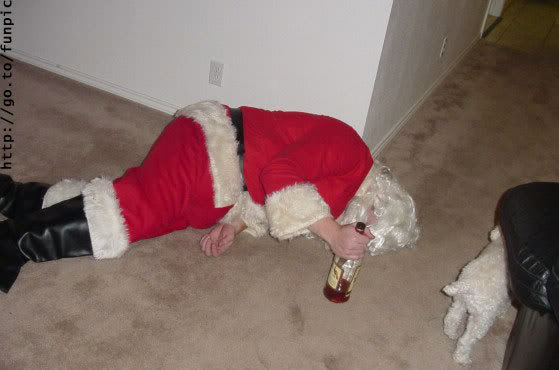
For example, start putting a plastic pickle in your Christmas tree to remind you and your family of that first Christmas in a different house.
Subscribe to:
Posts (Atom)